
How to say happy birthday in Thai (plus New Year, Christmas)
To say happy birthday in Thai, say suk san wan koet (สุขสันต์วันเกิด) — literally "happy birth day." The same suk san wan (สุขสันต์วัน) pattern extends to other occasions: swap in pi mai for New Year, or Christmas for Christmas.
Happy birthday in Thai: suk san wan koet
Suk san (สุขสันต์) means "happy" or "blessed," and wan koet (วันเกิด) means "birthday" — literally "day born." Put together, suk san wan koet is the standard way to wish someone a happy birthday, and it works in any context, from a close friend to a work colleague. Adding khrap or kha at the end is optional but polite, the same as with most Thai phrases directed at another person.
Making merit: a Thai birthday custom worth knowing
Beyond the phrase itself, many Thai Buddhists mark a birthday with tham bun (ทำบุญ) — making merit — rather than treating it purely as a party occasion. That can mean offering food to monks at a temple, donating money or supplies, or releasing birds or fish as an act of goodwill. It's not universal or obligatory, and plenty of birthdays in Thailand look like birthdays anywhere else — cake, a gathering, gifts — but if a Thai friend or colleague mentions doing something at a temple on their birthday, this is the custom behind it.
If you're invited to a Thai colleague's or friend's celebration and want a broader phrase base beyond this one occasion, the basic Thai phrases guide is a good place to build from.
Happy New Year in Thai: sawasdee pi mai
Sawasdee pi mai (สวัสดีปีใหม่) is the standard Happy New Year greeting, used for the January 1 new year the same way it's used at Songkran, Thailand's traditional New Year in April — covered in more detail here if you want the fuller picture of how Thailand marks both. January 1 is a public holiday in Thailand, and sawasdee pi mai is exactly what you'd say to a colleague or friend at any point around it.
Merry Christmas in Thai: suk san wan Christmas
Suk san wan Christmas (สุขสันต์วันคริสต์มาส) follows the same pattern, with the English word Christmas borrowed directly into Thai. Worth knowing for context: Christmas isn't a public holiday in Thailand, since the country is majority Buddhist, but it's widely celebrated commercially and socially, especially in Bangkok and other cities with sizable expat and Christian communities. Malls decorate for it, offices sometimes hold parties, and it's a completely normal thing to wish a Thai coworker or friend if they mention celebrating.
| Occasion | Thai phrase | Literal sense |
|---|---|---|
| Birthday | สุขสันต์วันเกิด (suk san wan koet) | "Happy birth-day" |
| New Year | สวัสดีปีใหม่ (sawasdee pi mai) | "Hello new year" |
| Christmas | สุขสันต์วันคริสต์มาส (suk san wan Christmas) | "Happy Christmas-day" |
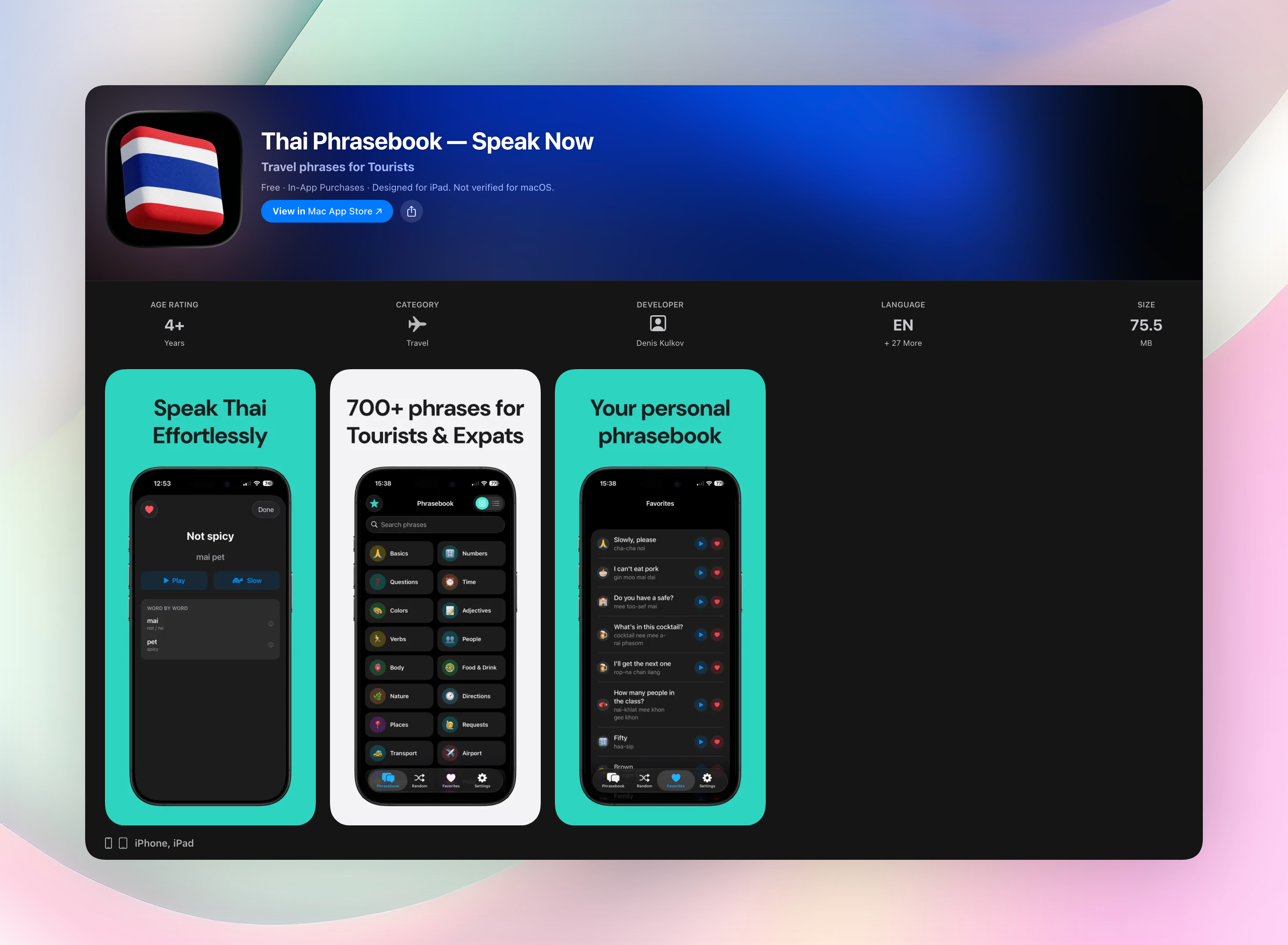
Getting the pronunciation right on a longer phrase like suk san wan koet is easier with something to listen to first. Thai Phrasebook, an offline Thai phrasebook app with 700+ real-world phrases across 16 categories, plays each of these greetings as native audio at full and slow speed, with readable phonetics alongside the Thai script.
FAQ
What's the literal meaning of suk san wan koet?
Suk san means "happy" or "blessed," and wan koet means "day born" — so it reads literally as "happy day-of-birth," which lines up neatly with the English "happy birthday."
Do Thai people sing "Happy Birthday" in English or Thai?
Both happen — plenty of Thai birthday parties sing the English "Happy Birthday to You" tune, sometimes with Thai lyrics layered in, especially in more Westernized settings like schools and offices in cities. There's no single fixed Thai birthday song replacing it nationwide.
Is Christmas celebrated in Thailand?
Not as a public holiday or a religious occasion for most of the population, since Thailand is majority Buddhist. But it's celebrated socially and commercially, particularly in Bangkok and tourist areas, with decorations, parties, and gift-giving common in offices, malls, and among Thailand's Christian and expat communities.
Can I use suk san wan for other celebrations too?
Yes — it's a productive pattern. Suk san wan plus the occasion's name works for holidays generally, which is why you'll see it for birthdays, Christmas, and other celebrations, not just the two covered here.
Free Thai Phrasebook tools
- Basic Thai Phrase Pack GeneratorChoose a situation, pack size, and display order to create a focused set of Thai phrases with the app's vetted script, romanization, and English gloss.
- Greetings in Thai Phrase SelectorChoose a situation, result count, and display mode to see matching greetings from the Thai Phrasebook corpus.
- Thai Alphabet QuizPractice recognizing Thai consonants and vowel forms in either direction. Choose a set and quiz length, then get an instant score and review.
- Thai Number ConverterConvert whole numbers and decimals to Thai numerals, Thai written readings, or both without sending anything to a server.
- Thai Year ConverterConvert a Thai Buddhist Era year or full date to Gregorian CE—or convert Gregorian CE to Thai BE—using the standard 543-year offset.