
How to say how are you in Thai (and how to answer)
To say how are you in Thai, ask sabai dee mai (สบายดีไหม). The expected answer is sabai dee (สบายดี) — I'm fine — or, if it's true, mai sabai (ไม่สบาย), which leans toward "I'm unwell" rather than a mild "not great."
Sabai dee mai: how are you in Thai
Sabai dee mai (สบายดีไหม) breaks down as sabai dee — "well" or "comfortable" — plus mai, the question particle that turns a statement into a yes/no question. It's the closest Thai equivalent to "how are you," though it functions more like a genuine check-in than the reflexive small talk the English phrase often is. You'll hear it from friends, family, and coworkers you haven't seen in a while more than from a stranger making conversation.
If you're building out from here, the basic Thai phrases guide covers greetings, numbers, and the situational phrases that come up alongside small talk.
How to answer sabai dee mai
Sabai dee (สบายดี) — dropping the question particle — means "I'm fine" or "I'm well," and it's the default, expected answer. If you're genuinely unwell, mai sabai (ไม่สบาย) is the phrase, but it carries more weight than a casual "not okay" — it's the word Thai speakers reach for to mean sick, whether that's a cold, an upset stomach, or something more serious. For a milder version of "not great" without implying illness, most people would rather explain the specific issue than use mai sabai loosely.
Either answer commonly gets khrap or kha attached: sabai dee kha, or sabai dee khrap.
Where are you? Small-talk starters
Two questions come up constantly once a conversation gets past hello. Khun yu thi nai (คุณอยู่ที่ไหน) — where are you? — asks about your current location, useful when arranging to meet someone or when someone's checking where you ended up. A related casual one, pai nai (ไปไหน) — literally "where are you going?" — functions as a greeting question in its own right rather than a real request for your itinerary, the way it's covered in how to say hello in Thai.
A third common opener is khun ma jak nai (คุณมาจากไหน) — where are you from? — genuinely useful for a visitor, since it's usually the first thing a Thai person will ask once they realize you're not local.
| Question | Thai | Meaning |
|---|---|---|
| Sabai dee mai | สบายดีไหม | How are you? |
| Khun yu thi nai | คุณอยู่ที่ไหน | Where are you (right now)? |
| Pai nai | ไปไหน | Where are you going? (often just a greeting) |
| Khun ma jak nai | คุณมาจากไหน | Where are you from? |
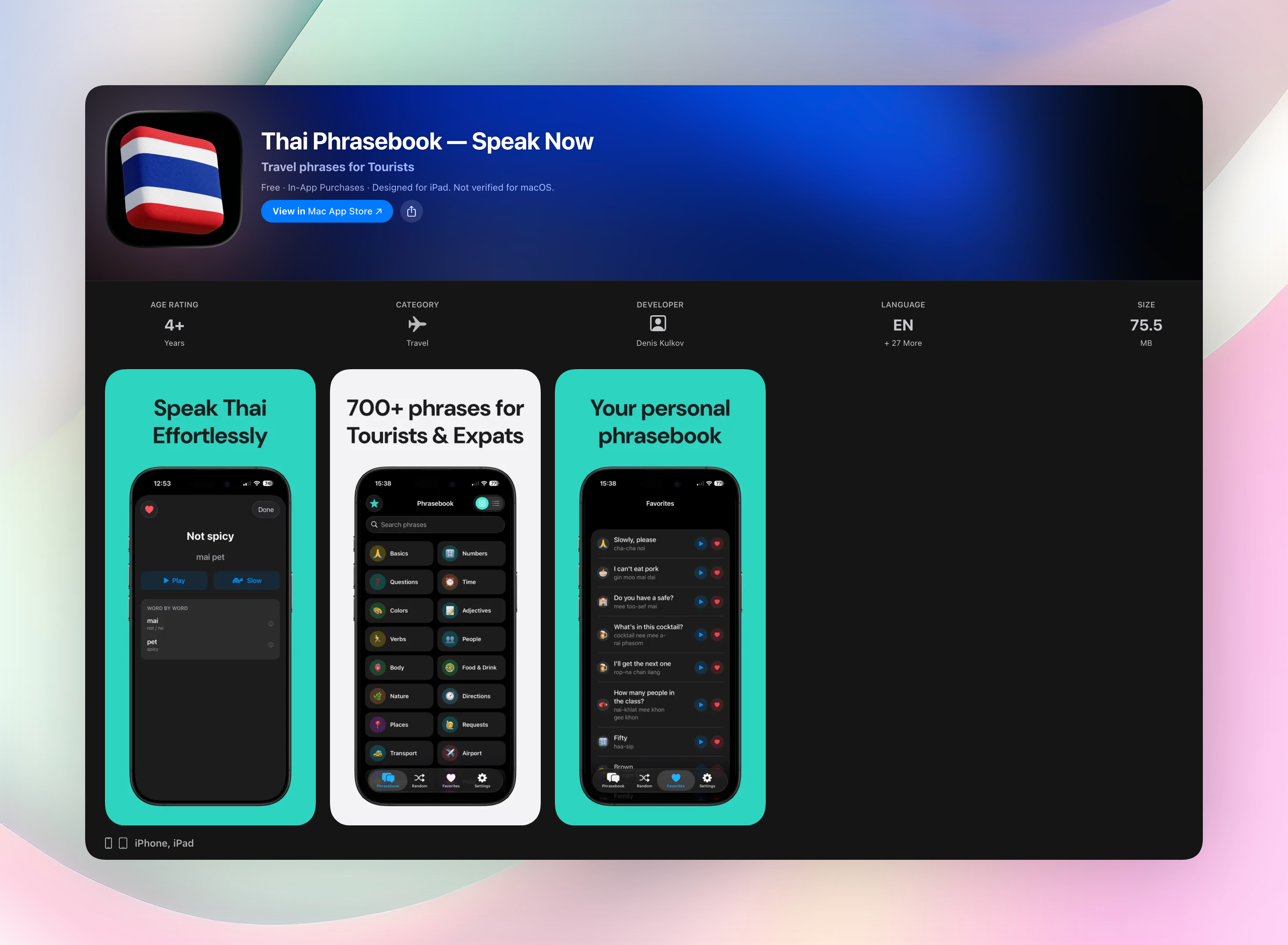
Answering questions like these on the fly is where a lot of beginners freeze up — not because the vocabulary is hard, but because hearing a question at conversational speed doesn't match the slow, careful pronunciation most study materials use. Thai Phrasebook, an offline Thai phrasebook app with 700+ real-world phrases across 16 categories, plays each phrase as native audio at both full and slow speed, with readable phonetics and word-by-word breakdowns to help close that gap.
FAQ
What's the standard answer to sabai dee mai?
Sabai dee (I'm fine), usually with khrap or kha attached. It's the default, expected response even in a lot of ordinary situations, similar to how "good, thanks" is the reflexive answer to "how are you" in English.
Does mai sabai always mean "sick"?
It leans strongly that way — it's the word Thai speakers use to say they're unwell, not a casual "meh, not great." If you just mean you're a bit tired or stressed rather than ill, describing the specific feeling comes across more accurately than mai sabai.
Is pai nai a real question I need to answer honestly?
Not really, especially from a friend or acquaintance passing you on the street — it's closer to "hey, what's up" than a genuine request for your destination. A vague answer like pai teo (ไปเที่ยว), "just going out," is a completely normal response.
How do I ask "how are you" to more than one person?
Sabai dee mai works the same whether you're asking one person or a group — Thai doesn't add a plural marker the way English adds "you all" or "you guys." Context makes clear who you're asking.
Free Thai Phrasebook tools
- Basic Thai Phrase Pack GeneratorChoose a situation, pack size, and display order to create a focused set of Thai phrases with the app's vetted script, romanization, and English gloss.
- Greetings in Thai Phrase SelectorChoose a situation, result count, and display mode to see matching greetings from the Thai Phrasebook corpus.
- Thai Alphabet QuizPractice recognizing Thai consonants and vowel forms in either direction. Choose a set and quiz length, then get an instant score and review.
- Thai Number ConverterConvert whole numbers and decimals to Thai numerals, Thai written readings, or both without sending anything to a server.
- Thai Year ConverterConvert a Thai Buddhist Era year or full date to Gregorian CE—or convert Gregorian CE to Thai BE—using the standard 543-year offset.