
The basic Thai phrases you actually need for Thailand
The basic Thai phrases you need cover five situations: greetings, numbers, food, getting around, and asking for help. Add khrap if you're a man or kha if you're a woman to almost anything you say, and a few dozen words carry you through most of a trip to Thailand.
The basic Thai phrases for greetings and politeness
Sawasdee (สวัสดี) is the one word that covers hello, good morning, good afternoon, and good evening — Thai doesn't split greetings by time of day the way English does. Say it with khrap after it if you're a man (sawasdee khrap) or kha if you're a woman (sawasdee kha), and you've covered the phrase you'll use more than any other.
Khrap and kha are polite particles, not translations of anything — they don't add meaning, they add register. Drop them with close friends or kids, keep them with staff, strangers, and anyone older than you, and you'll sound polite without sounding stiff. Thai's other everyday politeness marker is the wai: press your palms together, fingers pointing up, and give a small bow of the head. Thais generally wai first when greeting someone senior or a monk; as a visitor, a nod and a smile back is enough, though returning a wai is always fine.
Common Thai phrases for thanks, sorry, and small requests
Khob khun (ขอบคุณ) is thank you — say khob khun khrap or khob khun kha and you've handled most service interactions in the country. Khor thot (ขอโทษ) covers both sorry and excuse me, so the same word works whether you're apologizing or squeezing past someone on a train. Mai pen rai (ไม่เป็นไร) means it's fine, no worries — Thais say it back after khob khun the way English speakers say "you're welcome," and it also works to wave off a small mistake.
Thai numbers you'll actually use
Numbers come up constantly — prices, room numbers, phone numbers, bus numbers. One through ten: neung (1), song (2), sam (3), si (4), ha (5), hok (6), jet (7), paet (8), kao (9), sip (10). Two irregularities trip up learners fast: twenty is yee sip, not song sip, and a number ending in one uses et instead of neung — so 21 is yee sip et, not yee sip neung. Everyday life runs on ordinary Arabic numerals; the separate Thai numeral script mostly shows up on temple plaques, some banknotes, and lottery tickets, so skipping it costs you nothing practical.
Thai phrases for travel when you're ordering food
At a restaurant, thao rai (เท่าไหร่) — how much — gets you a price on anything without a menu. Phet (เผ็ด) means spicy; say mai phet (ไม่เผ็ด) if you want a dish toned down, since Thai spice levels default hotter than most visitors expect. Aroy (อร่อย) is delicious, and saying it after a meal is basically a national pastime. When you're ready to leave, chek bin (เช็คบิล) — a direct loan from "check bill" — is what Thais actually say to ask for the bill.
Getting around: taxis, directions, and addresses
Taxi drivers and songthaew stops respond well to a short, direct request: pai [place] khrap/kha (ไป...ครับ/ค่ะ) — simply "go to [place]." Trong pai (ตรงไป) is straight ahead, leeo sai (เลี้ยวซ้าย) is turn left, and leeo khwa (เลี้ยวขวา) is turn right. In Bangkok specifically, chuay poet miter duay (ช่วยเปิดมิเตอร์ด้วย) — please turn on the meter — is worth memorizing verbatim; some drivers quote a flat fare instead of using the meter, and asking for it by name heads off the negotiation before it starts.
Bargaining and shopping
At markets — not fixed-price stores — lot dai mai (ลดได้ไหม), "can you lower it?", is the standard opening move, and most vendors expect it. Phaeng (แพง) is expensive, thuk (ถูก) is cheap, and adding pai after phaeng, as in phaeng pai, means "too expensive." None of this applies in a 7-Eleven or a mall — prices there are fixed, and asking to bargain just gets you a confused look.
An (อัน) — "this one" — paired with pointing covers you when you don't know the name of what you're buying, which in a Thai market is often. Ao an nee (เอาอันนี้) means "I'll take this one," and it pairs naturally with thao rai to close out a purchase in two short phrases.
Phrases for your hotel or guesthouse
Mee hong wang mai (มีห้องว่างไหม) — do you have a room available? — is the phrase to lead with if you're walking into a guesthouse without a booking. Chek in (เช็คอิน) and chek aut (เช็คเอาท์) are check-in and check-out, borrowed straight from English and understood everywhere from hostels to five-star hotels. If something's wrong with the room, ae sia (แอร์เสีย) reports a broken air conditioner, and khor pha chet tua peuim (ขอผ้าเช็ดตัวเพิ่ม) asks for extra towels.
Small talk and meeting people
Yindee thi dai ruchak (ยินดีที่ได้รู้จัก) — nice to meet you — is a step up from sawasdee for anyone you're actually being introduced to, rather than just passing on the street. Chai mai (ใช่ไหม), tacked onto the end of a statement, works like the English tag "right?" — useful for checking you understood a price or a direction correctly. And khor thang noi (ขอทางหน่อย) — excuse me, coming through — earns its keep in any crowded market or train aisle, which in Thailand is most of them.
Emergencies and asking for help
Chuay duay (ช่วยด้วย) — help! — is the one phrase worth having reflexively. For anything less urgent, mai khao jai (ไม่เข้าใจ) tells someone you don't understand, and phut phasa angkrit dai mai (พูดภาษาอังกฤษได้ไหม) asks if they speak English. Rong phayaban (โรงพยาบาล) is hospital and tamruat (ตำรวจ) is police — two words worth recognizing even if you never have to say them yourself.
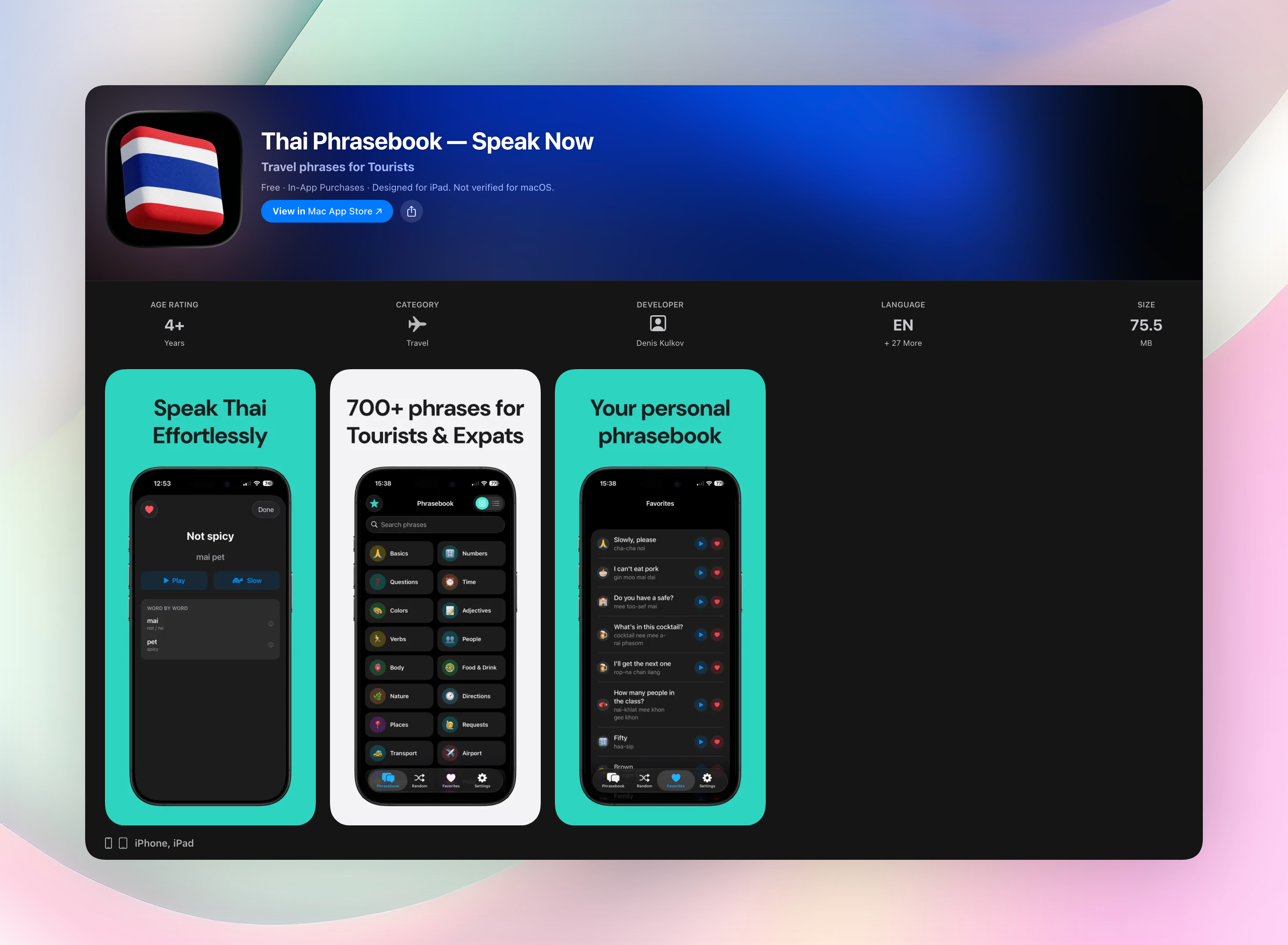
Getting the tone right on any of these is the part a written phrase can't teach. Thai Phrasebook, an offline Thai phrasebook app with 700+ real-world phrases across 16 categories, plays native audio at full and slow speed for each one alongside readable phonetics and word-by-word breakdowns, so you can hear a phrase before you try it out loud.
Khrap vs. kha, at a glance
The particle is the only thing that changes across these common phrases — the rest of the phrase stays identical for everyone.
| Phrase | Thai | Said by a man | Said by a woman |
|---|---|---|---|
| Hello | สวัสดี | sawasdee khrap | sawasdee kha |
| Thank you | ขอบคุณ | khob khun khrap | khob khun kha |
| Sorry / excuse me | ขอโทษ | khor thot khrap | khor thot kha |
| Yes, okay | (particle alone) | khrap | kha |
FAQ
Do I have to say khrap or kha every time I speak?
No, but adding it to your first phrase in any interaction — a greeting, a thank you, a question to staff — reads as polite and covers for mistakes in the rest of your sentence. Close friends and children usually drop it with each other.
Is it rude to try speaking Thai and get it wrong?
No — generally the opposite. Thais tend to respond warmly to a visitor attempting Thai, even with off tones or shaky grammar, and will usually help or gently correct rather than mock. Getting a tone wrong is common enough that people expect it from a beginner.
Do most people in Thailand speak English?
It varies a lot by location. Bangkok, Phuket, Chiang Mai, and other major tourist areas have plenty of English-speaking staff in hotels and restaurants; smaller towns, local markets, and bus or train stations often don't — which is exactly where a handful of Thai phrases earns its keep.
What's the single most useful Thai phrase to know?
Khob khun khrap/kha (thank you) and sawasdee khrap/kha (hello) cover the most ground per word. You'll use both dozens of times a day, and both signal politeness even when the rest of your sentence falls apart.
How many Thai phrases do I really need to know before a trip?
Thirty to forty covers a huge amount: greetings, thanks, numbers, a handful of food and transport words, and one or two emergency phrases. That's a realistic weekend of casual review, not a language course — fluency isn't the goal, being polite and getting understood is.
Free Thai Phrasebook tools
- Basic Thai Phrase Pack GeneratorChoose a situation, pack size, and display order to create a focused set of Thai phrases with the app's vetted script, romanization, and English gloss.
- Greetings in Thai Phrase SelectorChoose a situation, result count, and display mode to see matching greetings from the Thai Phrasebook corpus.
- Thai Alphabet QuizPractice recognizing Thai consonants and vowel forms in either direction. Choose a set and quiz length, then get an instant score and review.
- Thai Number ConverterConvert whole numbers and decimals to Thai numerals, Thai written readings, or both without sending anything to a server.
- Thai Year ConverterConvert a Thai Buddhist Era year or full date to Gregorian CE—or convert Gregorian CE to Thai BE—using the standard 543-year offset.