Songkran Thai New Year: dates, greetings, and water-fight etiquette
Songkran is Thailand's traditional New Year, celebrated April 13–15 with a mix of religious ritual and the country's famous nationwide water fights. The greeting to use is sawasdee pi mai (สวัสดีปีใหม่) — happy new year — or the more specific suk san wan songkran (สุขสันต์วันสงกรานต์), happy Songkran.
What Songkran actually is
Songkran marks the traditional Thai lunar new year, and its roots are religious and family-centered, not aquatic. The core ritual is pouring water gently over Buddha images at temples, and over the hands of parents, grandparents, and elders at home, as a gesture of cleansing and respect that carries a blessing for the year ahead — a practice called rot nam dam hua. Younger family members visit older relatives specifically to perform this, often alongside a wai.
The street-level water fights most visitors picture — buckets, water guns, pickup trucks full of people soaking passersby — grew out of that gentler tradition over recent decades and are now the part most associated with the holiday, especially in tourist areas like Bangkok's Silom Road or Chiang Mai's old city moat. Both layers run at once: solemn family ritual in the morning, citywide water fight by afternoon, often within the same neighborhood.
If Songkran is your first stop into Thai phrases generally, the basic Thai phrases guide is a good place to build out from here.
When Songkran falls
The official public holiday runs April 13 to 15 every year, and it's fixed to the solar calendar rather than shifting like Chinese New Year does. In practice, many workplaces and some regions extend the celebration with additional connected days off, so check specific dates for the year you're traveling rather than assuming exactly three days.
Songkran greetings to know
Sawasdee pi mai (สวัสดีปีใหม่) is the general "happy new year" greeting, usable at Songkran the same way it's used for the January 1 new year. Suk san wan songkran (สุขสันต์วันสงกรานต์) is more specific to this festival and follows a pattern you'll see again for other Thai holidays: suk san (สุขสันต์, "happy/blessed") plus wan (วัน, "day") plus the occasion's name. Either greeting is understood and appreciated if you're wished well by a Thai host or family during the holiday and want to say it back.
Water-festival etiquette for travelers
If you're in Thailand during mid-April, especially in a major city, plan on getting wet the moment you step outside — this isn't optional in tourist areas, and fighting it just gets you soaked anyway. Waterproof your phone and valuables before you leave your hotel; a dry bag or a cheap waterproof phone case is standard gear for the week, not overkill. Alongside water, you'll often see people smear a white powder paste on each other's cheeks as part of the fun — it washes off and is meant good-naturedly.
Read the room before you soak someone. People clearly dressed for work, riding a motorbike in traffic, or in monk's robes are generally left alone or treated more gently, and older people performing the rot nam dam hua ritual at a family gathering are in a different mode entirely from a street water fight — that moment calls for a quiet, respectful gesture, not a bucket. Outside of that, the water fights are genuinely good-natured chaos, and joining in is usually welcomed.
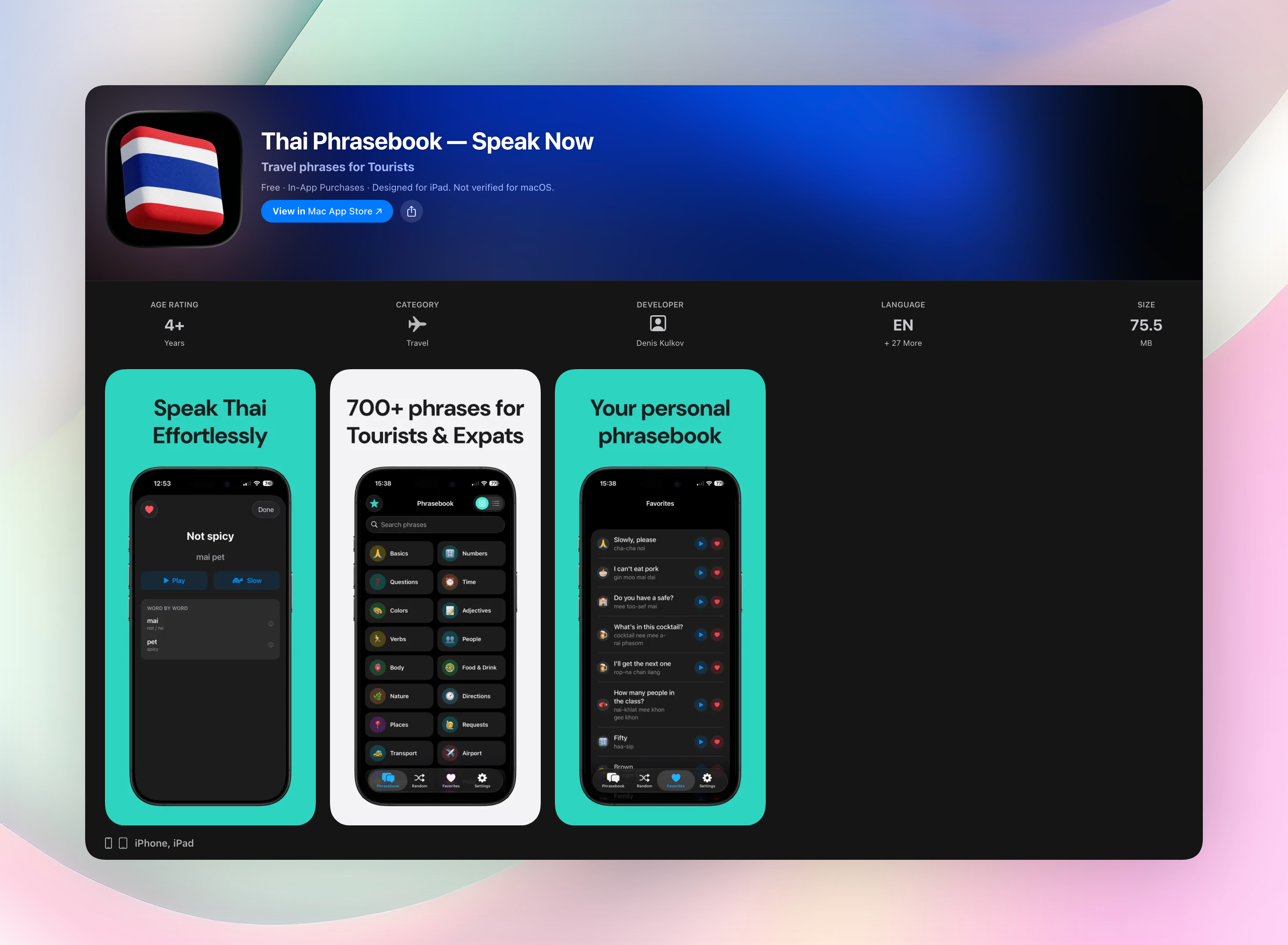
Even amid the splashing, Thai Phrasebook, an offline Thai phrasebook app with 700+ real-world phrases across 16 categories, works without a connection and plays native audio at full and slow speed, so a quick sawasdee pi mai is ready to go even if you're nowhere near WiFi.
Songkran vs. Loi Krathong
Thailand's other major festival greeting occasion is Loi Krathong, and travelers often mix the two up since both involve water. They're not the same celebration at all.
| Songkran | Loi Krathong | |
|---|---|---|
| When | April 13–15, fixed dates | Full moon of the 12th lunar month, usually November |
| What it marks | Traditional Thai New Year | Paying respects to the water spirit, letting go of misfortune |
| Main activity | Water fights, pouring water on Buddha images and elders | Floating a small decorated krathong on a river or canal |
| Typical greeting | Sawasdee pi mai / suk san wan songkran | No single fixed phrase; suk san wan loi krathong works |
| Mood | Loud, communal, soaking wet | Quiet, reflective, candlelit |
Loi Krathong greetings
Loi Krathong doesn't have one standard greeting phrase the way Songkran has sawasdee pi mai, since it isn't a new-year celebration — it's built around the act of releasing a krathong, not an exchange of words. If you want to wish someone well for it, suk san wan loi krathong (สุขสันต์วันลอยกระทง) — "happy Loi Krathong" — follows the same pattern as other Thai holiday greetings and will be understood as warm, if slightly less standard than the equivalent phrase for Songkran.
FAQ
What do you say to someone during Songkran?
Sawasdee pi mai (happy new year) works generally, and suk san wan songkran (happy Songkran) is the more specific version. Either is a fine thing to say back if someone wishes you well, or to offer first to Thai friends, colleagues, or hosts.
Is Songkran the same as Thai New Year?
Yes — Songkran is the traditional Thai New Year, distinct from the January 1 new year that Thailand also observes on the international calendar. Both get a sawasdee pi mai greeting, but Songkran is the one with religious ritual and public holiday status tied to it.
Do I have to participate in the water fights?
No. Staying dry is entirely possible by avoiding the busiest tourist streets and water-fight zones during peak hours, though in cities like Bangkok and Chiang Mai it's genuinely difficult to avoid all of it if you're out and about. Many travelers choose to embrace it rather than fight it.
Is Loi Krathong also a water festival?
Not in the sense Songkran is. Loi Krathong involves water only in that you float a small candlelit krathong on a river, canal, or pond — there's no splashing, dousing, or water fighting involved. It's a quieter, more reflective evening event.
Free Thai Phrasebook tools
- Basic Thai Phrase Pack GeneratorChoose a situation, pack size, and display order to create a focused set of Thai phrases with the app's vetted script, romanization, and English gloss.
- Greetings in Thai Phrase SelectorChoose a situation, result count, and display mode to see matching greetings from the Thai Phrasebook corpus.
- Thai Alphabet QuizPractice recognizing Thai consonants and vowel forms in either direction. Choose a set and quiz length, then get an instant score and review.
- Thai Number ConverterConvert whole numbers and decimals to Thai numerals, Thai written readings, or both without sending anything to a server.
- Thai Year ConverterConvert a Thai Buddhist Era year or full date to Gregorian CE—or convert Gregorian CE to Thai BE—using the standard 543-year offset.