Best 9 Ling App Alternatives in 2026: Top Picks for Every Learner
If you need Thai phrases you can use tonight and you’re not chasing a streak or a grammar tree, Thai Phrasebook is the best Ling app alternative. This list covers nine apps that swap the Ling app’s heavy approach for styles that build spoken confidence faster, with simpler tools for real conversations.
1. Thai Phrasebook — Speak Now
Best for: travellers and beginners who want phonetic, ready-to-say phrases right now.
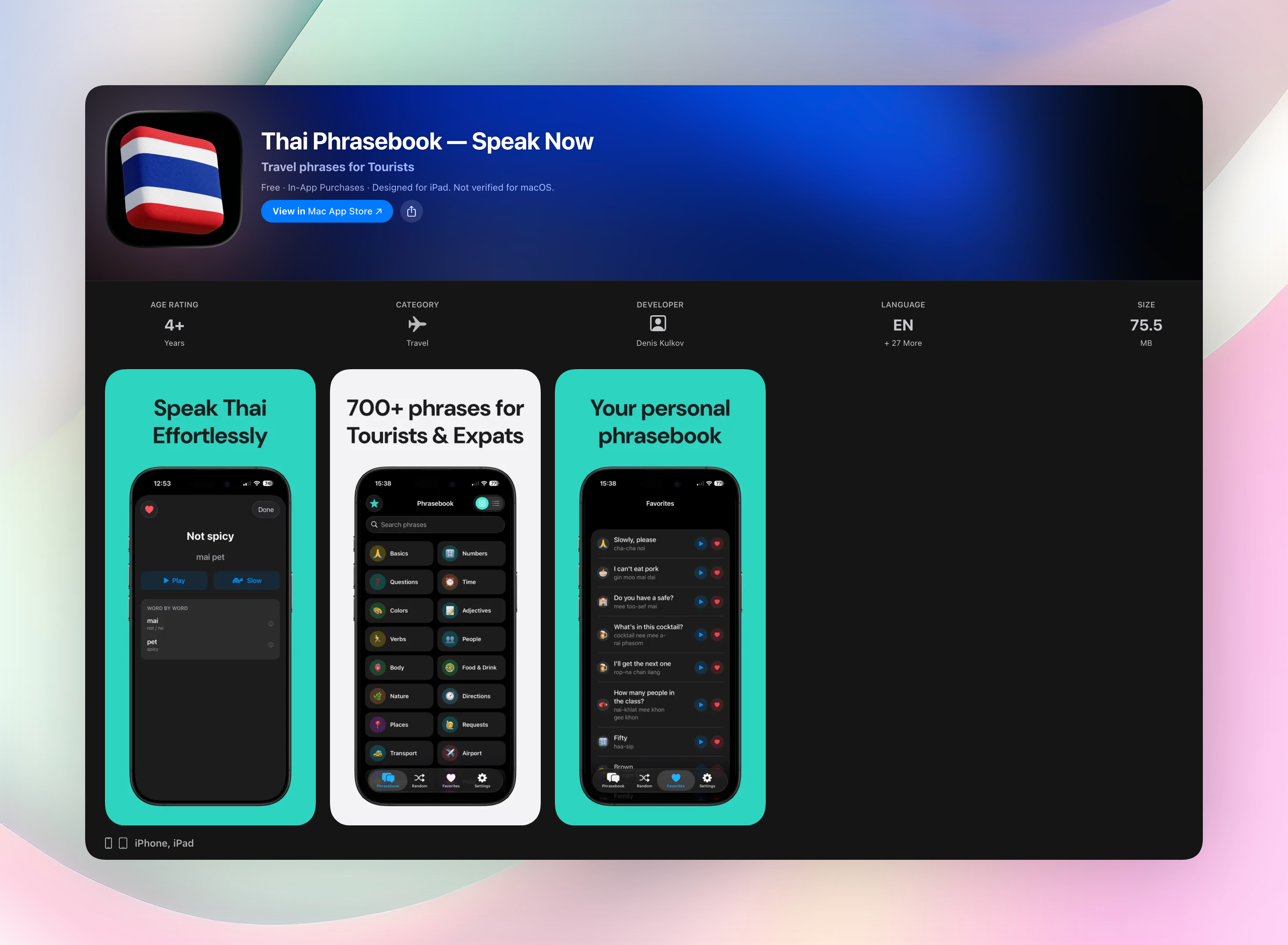
This isn’t a course. It’s a clean, searchable phrasebook organized by situation: airport, market, hotel, taxi. No grammar lessons, no vocabulary drills. You tap a category, hear a native speaker say the phrase, and repeat it. The audio is recorded by real Thai speakers, so you get the actual tones, not a robotic voice guessing at them.
The standout tool is the speed control. You can slow down any phrase without the pitch warping, which makes it the only app on this list that lets you pick apart tones before you speak. Everything works offline. No accounts, no ads, no subscription pop-ups. Just a one-time purchase.
- 16 real-world categories: Transport, Food, Hotel, Shopping, Dating, Small Talk, and more
- Native audio at full or half speed, with word-by-word breakdowns and notes
- Favorites list you build yourself for quick access anywhere
- Offline, no login required
Get Thai Phrasebook · Thai Phrasebook on the App Store
2. Duolingo
Best for: building a daily habit with bite-sized, game-like lessons in many languages.
Duolingo turns practice into a simple loop: quick matching, listening, and speaking exercises that feel more like a mobile game than study time. It’s easy to start, and the cheerful nudges keep you coming back. The streak counter keeps you hooked. Miss a day and you lose it, which sounds silly but works. Free with ads, premium removes them. For Thai, it won’t get you speaking fast, but it’s solid for learning the alphabet and basic words over time.
3. Memrise
Best for: memorising vocabulary fast with spaced repetition and street-level video clips.
Memrise drills words with flashcards timed to your forgetting curve, but it’s the short video clips of locals that set it apart. You hear how a word sounds in a real voice, in a real setting like a market or a kitchen, instead of a studio. The “Learn with Locals” clips anchor vocabulary to context, which helps your ear and your confidence. The free tier gives you core decks; paid adds more content and modes. Good for building listening recognition quickly.
4. Drops
Best for: visual learners who want to stack core words in five-minute daily sessions.
Drops pairs every word with a clean, custom illustration and keeps sessions strict at five minutes. You swipe, tap, and connect images to meaning. No long explanations, no spelling drills unless you want them. The time cap makes it feel light instead of overwhelming, yet those minutes add up to a solid base vocabulary. The free version limits daily time; premium lifts it. Works offline, so you can sneak in a session anywhere.
5. Pimsleur
Best for: audio-first learners who want to speak full sentences from day one.
Pimsleur is hands-free. A narrator prompts you, a native speaker models a phrase, and you respond aloud in the pause. It’s built for the car, a walk, or while you chop vegetables. The method uses graduated interval recall. Words pop back up at precisely timed moments to lock them in. You’ll be producing complete, understandable sentences after a few lessons. No screen required, but it’s a paid subscription and pace is fixed.
6. Rosetta Stone
Best for: learners who want total immersion, zero translations, and instant pronunciation feedback.
Rosetta Stone teaches through pictures and inference only. You’ll figure out grammar by pattern, not explanation, which feels slow at first but mimics how you learned your first language. Its TruAccent engine listens, scores you, and shows a waveform comparison against a native speaker. Useful if you’re self-conscious about your accent. Paid subscription, but the immersion approach builds thinking in the language rather than translating in your head.
7. Mondly
Best for: playing with AR and chatbot conversations that simulate real exchanges.
Mondly throws in augmented reality and a conversational bot alongside daily lessons. You can project a virtual character into your room and practice scripted-but-lifelike chats, with speech recognition prompting your responses. It covers lots of languages and feels modern. The core lessons are quick, but depth varies by language. Free gives you limited daily access; premium unlocks everything. Fun if you want to feel like you’re talking to someone, even alone.
8. Babbel
Best for: structured, expert-led courses that explain grammar in your native language.
Babbel’s short lessons don’t hide the grammar. They explain it in plain English, then push you into a realistic dialogue immediately. You’ll apply a rule right after seeing it, which sticks better than theory alone. The personalised review sessions recycle the words you trip on, but across different contexts, not just a flashcard repeat. Paid subscription, no free tier beyond a trial. Good for learners who like a clear curriculum and don’t mind a small price for quality.
9. Mango Languages
Best for: understanding sentence structure and cultural context through colour-coded breakdowns.
Mango highlights every phrase in matching colours that show how word order shifts between English and your target language. It feels like annotated notes, helping you build sentences instead of memorising isolated words. Culture notes are embedded in each chapter, explaining etiquette, gestures, and when a phrase is actually appropriate, not just what it means. Many libraries offer free access, otherwise it’s a paid subscription. Great for travellers who care about the why behind the words.
Quick comparison table
| App | Platform | Best for | Standout features |
|---|---|---|---|
| Thai Phrasebook | iOS | Instant, usable Thai phrases by situation | Native audio, pitch-safe slow speed, offline, no ads |
| Duolingo | iOS, Android | Daily habit and alphabet basics | Streak counter, game-like quick exercises |
| Memrise | iOS, Android | Memorising vocabulary with real video | Spaced repetition, “Learn with Locals” video clips |
| Drops | iOS, Android | Visual vocabulary in 5-minute bursts | Custom illustrations, five-minute session cap |
| Pimsleur | iOS, Android | Hands-free, conversational speaking | Audio-first, graduated interval recall |
| Rosetta Stone | iOS, Android | Immersion without translations | TruAccent waveform feedback, no English |
| Mondly | iOS, Android | AR and chatbot practice | AR character projection, conversational bot |
| Babbel | iOS, Android | Structured courses tied to your language | Grammar in plain English, personalised reviews |
| Mango Languages | iOS, Android | Cultural context and sentence construction | Colour-coded chunks, embedded culture notes |
How we picked these apps
We looked specifically for Ling app alternatives that move away from heavy grammar-translation drills and get you speaking faster, with better audio or more flexible formats. We tested each app’s onboarding, lesson quality, native-speaker audio, and how quickly you could produce a real, useful phrase. Platform availability mattered, and we favoured apps that work when Wi‑Fi doesn’t, because travellers often have spotty connections. Thai Phrasebook took the top slot because it solves the “help me say this in Thai right now” problem better than any other app we tested. It doesn’t try to teach you a language from scratch; it hands you the phrases, spoken clearly, and gets out of your way.
Frequently asked questions
Which Ling app alternative is best for absolute beginners who don’t read Thai script?
Thai Phrasebook. Every phrase is written in clear phonetic English alongside Thai script, so you can read and say it without knowing a single character. The native audio lets you check your pronunciation immediately.
Can I use these apps offline, or do they need constant internet?
Several work offline after initial setup. Thai Phrasebook, Drops, Pimsleur, and Rosetta Stone all function without a connection—important if you’re on a flight or in a market with no signal. Some, like Duolingo and Mondly, need internet for full features.
Do any of these apps teach tonal pronunciation correctly without a live tutor?
Thai Phrasebook handles tones particularly well by slowing native audio without distorting pitch, so you can hear the rise and fall clearly before you speak. Memrise’s local video clips also expose you to natural tonal variation. No app replaces a tutor, but these two get you closer than robotic text-to-speech ever will.
How is Thai Phrasebook different from spaced-repetition apps like Memrise?
Memrise trains you to remember individual words over time with flashcards. Thai Phrasebook gives you complete, situational phrases you can use in conversation right now—no drilling, no spaced recall, just a tap and speak. It complements a vocab app, but it doesn’t ask you to memorise anything first.
The verdict
Thai Phrasebook is the number one alternative for putting practical Thai phrases into your mouth immediately. No skill trees, no hearts to lose. If you want a full multi-language course, Pimsleur or Babbel fill that need well. But for a weekend market, a taxi ride, or checking into a hotel, this is the simplest tool you’ll find. Grab it, download the phrases once, and you’re set. Get Thai Phrasebook and start speaking tonight.
Free Thai Phrasebook tools
- Basic Thai Phrase Pack GeneratorChoose a situation, pack size, and display order to create a focused set of Thai phrases with the app's vetted script, romanization, and English gloss.
- Greetings in Thai Phrase SelectorChoose a situation, result count, and display mode to see matching greetings from the Thai Phrasebook corpus.
- Thai Alphabet QuizPractice recognizing Thai consonants and vowel forms in either direction. Choose a set and quiz length, then get an instant score and review.
- Thai Number ConverterConvert whole numbers and decimals to Thai numerals, Thai written readings, or both without sending anything to a server.
- Thai Year ConverterConvert a Thai Buddhist Era year or full date to Gregorian CE—or convert Gregorian CE to Thai BE—using the standard 543-year offset.