
Is Thai hard to learn? What is actually hard and what is not
Thai is genuinely hard in a few specific ways — tones and the script — and easier than expected in others, since its grammar skips verb conjugation, plurals, and grammatical gender entirely. The difficulty is front-loaded: the first few months are the steepest part, not a slow climb the whole way.
What's genuinely hard about Thai
Tones sit at the top of the list. Thai has five of them, and pitch is part of a word's identity, not just its emotional coloring — the wrong tone can turn one word into a completely different one. It takes real, sustained listening practice to hear the difference reliably, let alone reproduce it. The Thai tones guide walks through all five with a concrete example of how much a single tone can change a word's meaning.
The script is the second major hurdle. Thai has 44 consonants split across three tone classes, vowels that can appear before, after, above, or below the consonant they belong to, and no spaces between words in ordinary writing — a sentence runs together as one unbroken string, and knowing where one word ends and the next begins is itself a skill you build over time. Reading fluently takes real study; there's no shortcut.
A third genuine difficulty is the classifier system: counting objects requires an extra word specific to the category of thing you're counting, covered in more detail in the Thai numbers guide. And Thai has a wider range of formality levels than English — different vocabulary and pronoun choices depending on who you're speaking to and how polite the situation calls for.
What's easier than expected
Thai verbs don't conjugate. There's no equivalent of "I go / he goes / we went" — the verb form stays identical regardless of subject or tense, and time is instead conveyed through context or a separate time word. That single fact removes an entire category of memorization that trips up learners of most European languages.
Nouns don't pluralize either. There's no Thai equivalent of adding "-s" to a word — "one dog" and "three dogs" use the same word for dog, with the number (and its classifier) doing the work of indicating quantity. And Thai has no grammatical gender for nouns or objects at all — no masculine or feminine word categories to memorize the way French or Spanish requires. That's a separate thing from the gendered speaker pronouns and khrap/kha particles covered elsewhere on this site, which mark who's speaking, not what kind of noun something is.
Word order helps too: Thai is built subject-verb-object, the same basic order as English, which means sentence structure feels more familiar to an English speaker than it would coming from a language with a different underlying order. And there are no articles — no "a," "an," or "the" to place correctly, another category of rules English speakers spend years internalizing that Thai simply skips.
| Genuinely hard | Easier than expected |
|---|---|
| Five tones, meaning-changing | No verb conjugation |
| Script: 44 consonants, no word spacing | No plural markers |
| Classifiers for counting objects | No grammatical gender |
| Multiple formality/pronoun levels | Subject-verb-object word order, like English |
| No articles (a/an/the) |
A realistic starting point
Getting to basic conversational ability — greetings, simple requests, small talk — is realistic within a few months of consistent, focused practice, especially if you lean on audio early rather than trying to read the script cold. Full literacy in the writing system and comfort with the formality system take considerably longer and keep developing for years, even among people living in Thailand full-time. Neither timeline should discourage a beginner; you don't need reading fluency or perfect register-switching to have real, useful conversations.
Practical tips for beginners
Start with phonetically spelled phrases, not the Thai script — you'll be speaking correctly far sooner if you're not also decoding an unfamiliar writing system at the same time. Prioritize listening over reading in your first weeks, since tone is something you absorb by ear, not from a page. Don't let the classifier system block you from speaking early — dropping it marks you as a beginner but still gets you understood. And keep khrap or kha attached to what you say from day one; it's the cheapest, fastest way to sound polite, and it works long before your grammar or tones are solid.
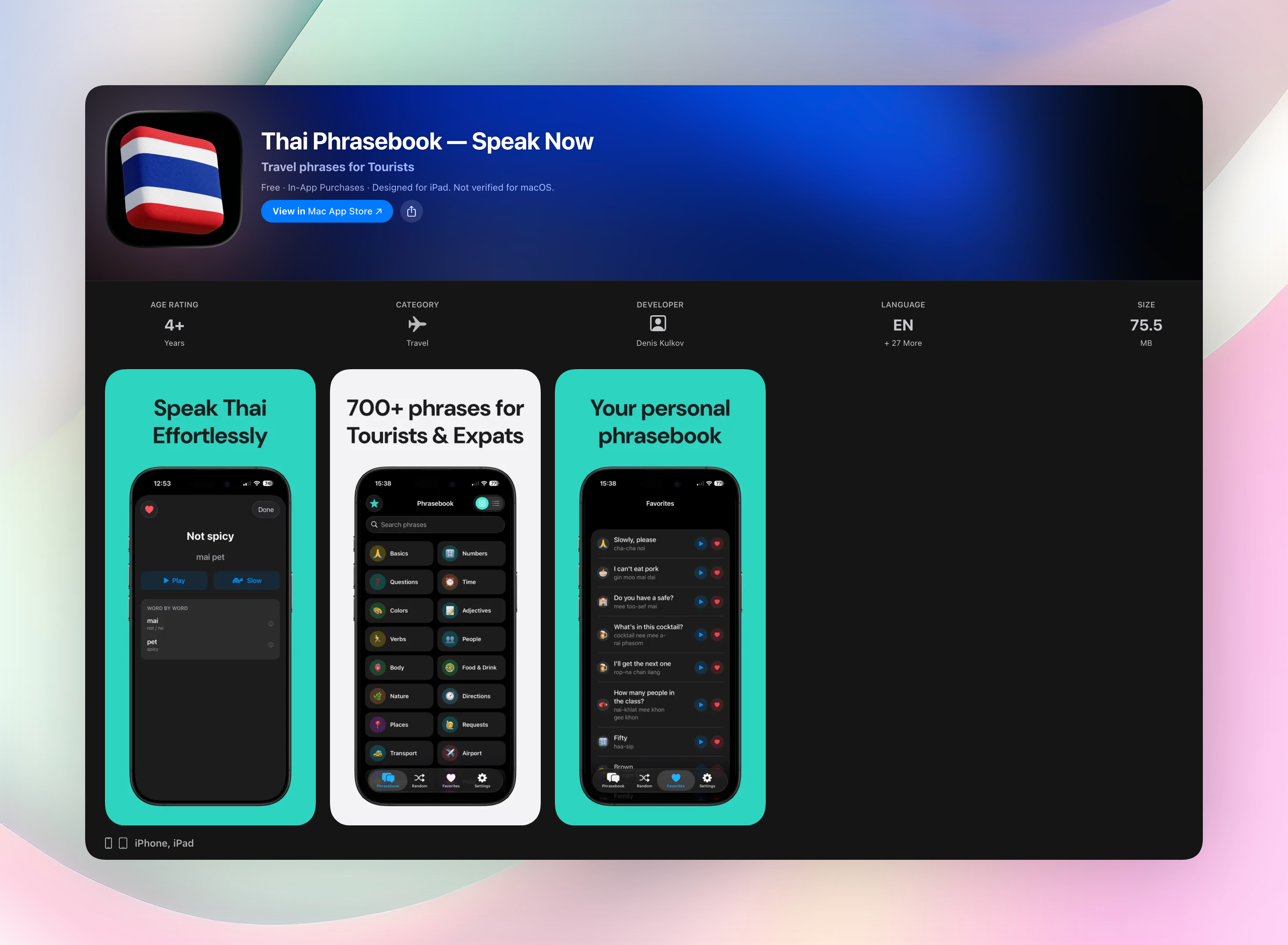
Thai Phrasebook, an offline Thai phrasebook app with 700+ real-world phrases across 16 categories, is built around exactly this starting point: native audio at full and slow speed, readable phonetics instead of raw script, and word-by-word breakdowns with nuance notes, so you're speaking real phrases correctly before you've tackled the alphabet.
FAQ
How long does it take to become conversational in Thai?
A few months of consistent practice gets most learners to a genuinely useful conversational level — greetings, requests, small talk. Reading the script fluently and mastering the formality system both take considerably longer.
Do I need to learn the Thai alphabet to speak Thai well?
No, not to start. Speaking accurately depends far more on hearing and reproducing tones correctly than on reading Thai script, so many learners build real speaking ability using phonetic spellings and audio before they ever tackle the writing system.
Is Thai grammar simple?
In several respects, yes — no verb conjugation, no plurals, no grammatical gender, and English-like subject-verb-object word order all remove sources of complexity common in other languages. The classifier system and the range of formality levels are the main grammar-adjacent complications that remain.
What's the single hardest part of Thai for an English speaker?
Tones, consistently. Getting the script down takes dedicated study, but tones require retraining your ear to treat pitch as meaningful rather than just expressive — something English simply doesn't ask of a listener, which makes it the adjustment that takes the longest to feel natural.
Free Thai Phrasebook tools
- Basic Thai Phrase Pack GeneratorChoose a situation, pack size, and display order to create a focused set of Thai phrases with the app's vetted script, romanization, and English gloss.
- Greetings in Thai Phrase SelectorChoose a situation, result count, and display mode to see matching greetings from the Thai Phrasebook corpus.
- Thai Alphabet QuizPractice recognizing Thai consonants and vowel forms in either direction. Choose a set and quiz length, then get an instant score and review.
- Thai Number ConverterConvert whole numbers and decimals to Thai numerals, Thai written readings, or both without sending anything to a server.
- Thai Year ConverterConvert a Thai Buddhist Era year or full date to Gregorian CE—or convert Gregorian CE to Thai BE—using the standard 543-year offset.