
How to say I love you in Thai (plus miss you and beautiful)
To say I love you in Thai, a man says phom rak khun (ผมรักคุณ) and a woman says chan rak khun (ฉันรักคุณ) — the pronoun for "I" changes by the speaker's gender, while rak khun (love you) stays the same. Between partners, swapping khun for the softer ter (เธอ) is common too.
I love you in Thai: phom rak khun and chan rak khun
Rak (รัก) is the verb "to love," and khun (คุณ) is a polite, general "you." Men lead with phom (ผม) for "I": phom rak khun. Women lead with chan (ฉัน): chan rak khun. Both are grammatically correct and understood everywhere; which one you use depends on your own gender, the same rule that governs khrap and kha.
Among romantic partners specifically, khun can feel a touch formal — the word you'd use with a stranger or a boss. Swapping it for ter (เธอ), an affectionate "you" reserved for people you're close to, softens the phrase: phom rak ter or chan rak ter. Both versions are heard between Thai couples; ter just reads warmer.
One nuance worth knowing: chan is technically usable by any speaker regardless of gender, and does show up from men in texting, song lyrics, and softer registers. In everyday spoken Thai, though, phom is still the default first-person pronoun for men, and chan for women.
Is it common for Thai people to say I love you out loud?
It's genuine and meaningful between partners, but Thai culture doesn't treat "I love you" as a phrase you say casually or often the way it's sometimes used in the West. A lighter, earlier-stage phrase is chorb (ชอบ) — "like" — which often gets said before rak in a relationship, roughly the way "I like you" precedes "I love you" in English dating. If you're learning the phrase as a novelty rather than to say it to someone specific, know that a stranger hearing phom/chan rak khun from you will likely find it funny or charming rather than take it as a serious declaration — context does the work here, same as it would in any language.
For more everyday, lower-stakes phrases to build from, the basic Thai phrases guide is a better starting point than jumping straight to a love confession.
How to say miss you in Thai
Khid thueng (คิดถึง) is miss you, and it's used constantly — with partners, friends, and family, not just romantically. Literally it means "think of" or "think about," and Thai typically drops the subject and object entirely: khid thueng on its own, with no pronoun attached, is understood as "I miss you." It's a much lighter, more frequently used phrase than rak khun, and a natural thing to text someone after you've said goodbye.
Beautiful, handsome, and cute in Thai
Suay (สวย) is beautiful, and it's used for women and for things — a beautiful view, a beautiful dress. Lor (หล่อ) is the equivalent for men: handsome. Calling a man suay would sound off to a Thai ear the same way calling a man "pretty" instead of "handsome" reads oddly in English — the words aren't interchangeable across genders. Na rak (น่ารัก), cute, sidesteps the whole issue: it's used for anyone, and for pets, babies, and objects too.
| Word | Thai | Typically used for |
|---|---|---|
| Beautiful | สวย (suay) | Women, places, things |
| Handsome | หล่อ (lor) | Men |
| Cute | น่ารัก (na rak) | Anyone, pets, objects |
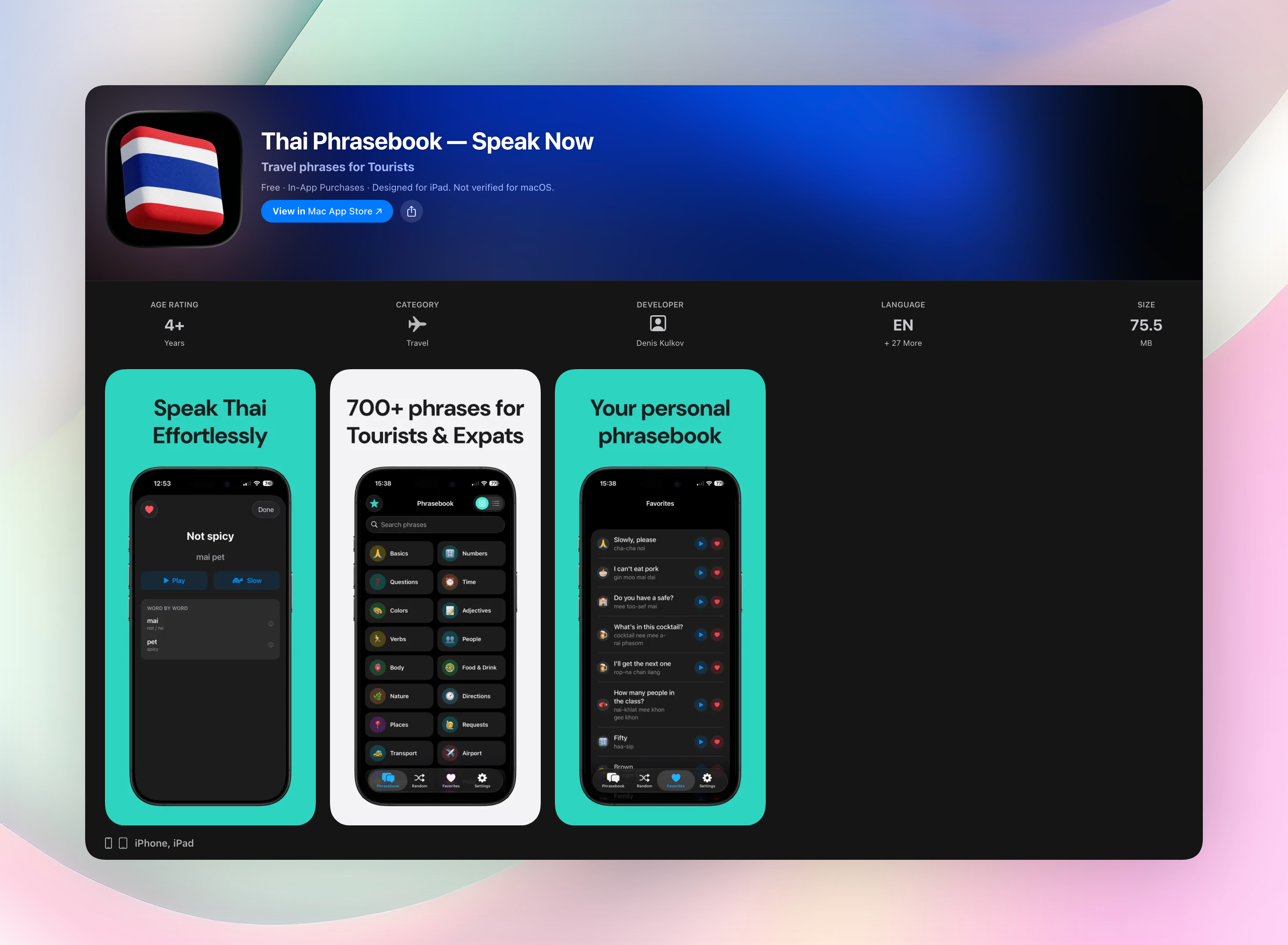
Getting the tone right on any of these matters — a flat or wrong tone can shift suay toward a different word entirely. Thai Phrasebook, an offline Thai phrasebook app with 700+ real-world phrases across 16 categories, plays rak khun, khid thueng, and the compliments above as native audio at full and slow speed, with word-by-word breakdowns and nuance notes for exactly this kind of phrase.
FAQ
Is chan only used by women in Thai?
Chan is grammatically available to any speaker, but in everyday spoken Thai, men default to phom for "I" and women default to chan. You'll still hear or read chan from men in texting, lyrics, and more casual or literary contexts.
What's a more casual way to say I love you in Thai?
Rak na (รักนะ) is a softer, more casual version — na is a gentle particle that takes some of the weight off the statement, closer to "love ya" than a formal declaration. It's common between close friends and family, not only romantic partners.
What's the difference between chorb and rak?
Chorb (ชอบ) means "like," and it's often the earlier, lighter thing said in a new relationship, similar to how "I like you" tends to come before "I love you" in English. Rak (รัก) is the stronger, more committed word.
How do you respond if someone says rak khun to you?
If you feel the same, you can say it back: phom/chan rak khun (duay) — "I love you too," with duay (ด้วย) meaning "also" tacked on. If you're not ready to reciprocate, khob khun na (thank you) is a common, gentle way to acknowledge it without matching the declaration.
Free Thai Phrasebook tools
- Basic Thai Phrase Pack GeneratorChoose a situation, pack size, and display order to create a focused set of Thai phrases with the app's vetted script, romanization, and English gloss.
- Greetings in Thai Phrase SelectorChoose a situation, result count, and display mode to see matching greetings from the Thai Phrasebook corpus.
- Thai Alphabet QuizPractice recognizing Thai consonants and vowel forms in either direction. Choose a set and quiz length, then get an instant score and review.
- Thai Number ConverterConvert whole numbers and decimals to Thai numerals, Thai written readings, or both without sending anything to a server.
- Thai Year ConverterConvert a Thai Buddhist Era year or full date to Gregorian CE—or convert Gregorian CE to Thai BE—using the standard 543-year offset.