Best 9 Drops Alternatives in 2026: Apps That Skip the Streak
Introduction
Thai Phrasebook is the best Drops alternative for anyone who needs conversational Thai phrases right now, no games, no filler. We gathered 9 mobile apps that replace Drops’ quick-hit vocabulary style, sorted by what each does best. You’ll find travel phrasebooks, full language courses, and vocabulary drill tools.
Quick comparison table
| App | Best for | Free tier | Offline | Platform |
|---|---|---|---|---|
| Thai Phrasebook | Travel phrases | Free starter pack | Full offline | iOS |
| Duolingo | Daily habit building | Ad-supported free | Limited offline | iOS, Android |
| Memrise | Real-life video clips | Free with ads | Pro only | iOS, Android |
| Babbel | Structured conversation | Free trial | Limited offline | iOS, Android |
| Busuu | Community feedback | Free basic | Premium only | iOS, Android |
| Rosetta Stone | Immersion without translation | Free trial | Full offline | iOS, Android |
| Clozemaster | Sentence gap-fill drills | Free with ads | Free offline | iOS, Android |
| Mango Languages | Practical conversation | Free via libraries | Full offline | iOS, Android |
| Ling | Mini-game vocabulary | Freemium | Limited offline | iOS, Android |
1. Thai Phrasebook
Best for: travelers who need spoken Thai phrases organized by real situation, instantly, without memorizing single words.
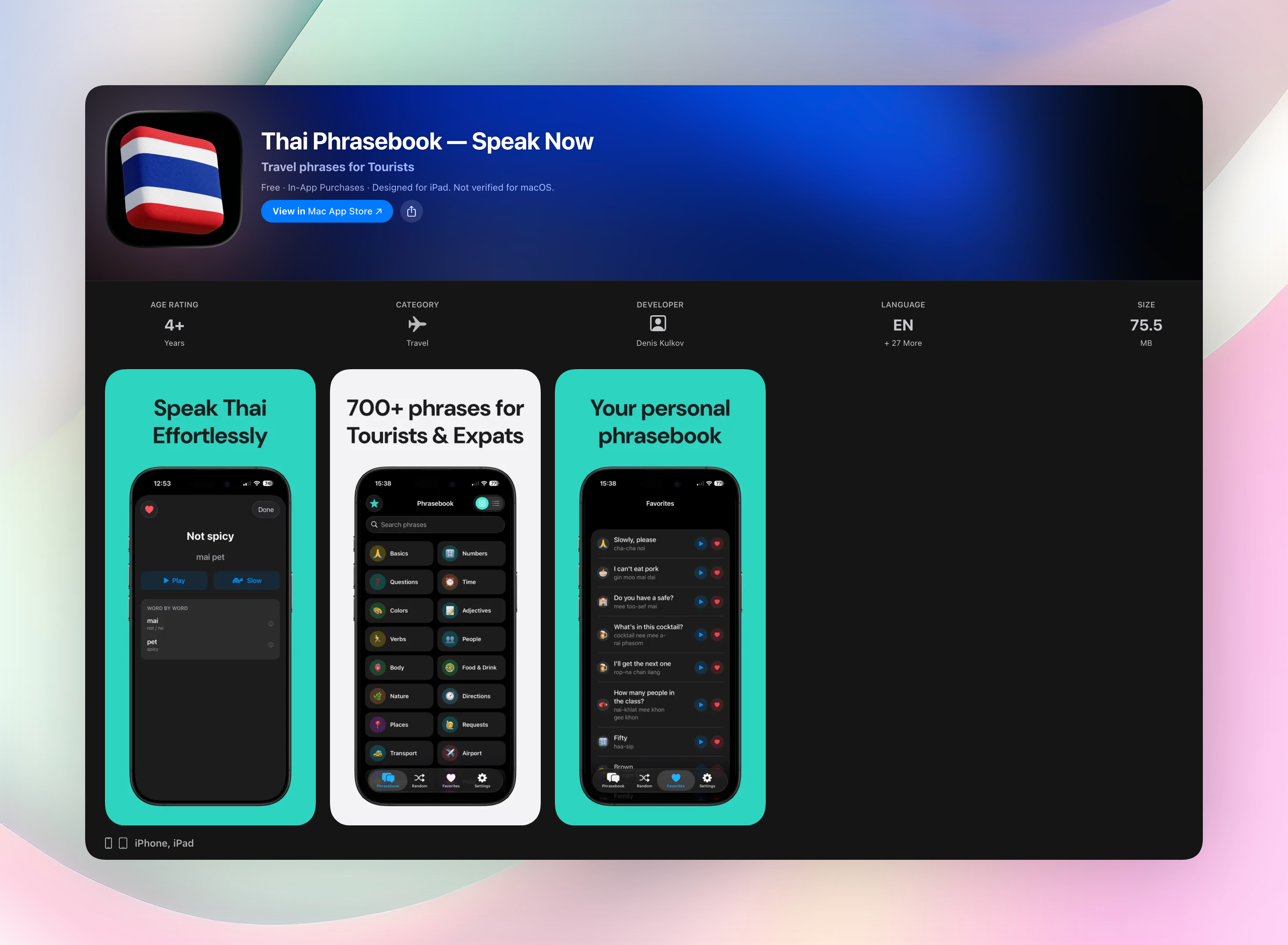
It skips vocabulary lists entirely and gives you over 1,000 practical phrases with clear native audio. Every phrase lives inside categories you’ll actually use: airport, taxi, hotel, restaurant, shopping, small talk, and more. Tap a category, tap a phrase, and hear it spoken at full speed or slowed down. No account setup, no login, just open and use.
Standout features:
- 16 real-world categories that match typical travel scenarios, from ordering food to asking for directions
- Native audio on every phrase, with optional slow playback and a “Speak Now” mode that lets you repeat after the speaker and compare your pronunciation
- Word-by-word breakdowns with teaching notes that explain nuance so you understand what you’re saying
- Favorites system to build a personal cheat sheet you can pull up in seconds
- Full offline access—works in airplane mode, on the subway, or anywhere without data
The free version includes a starter phrase pack so you can try it before a single affordable upgrade unlocks everything. It’s ad-free, no-nonsense, and built for someone who needs Thai right now, not after a 30-day streak.
Get Thai Phrasebook · Thai Phrasebook on the App Store
2. Duolingo
Best for: building a daily language habit with bite-sized, gamified lessons across dozens of languages, but not Thai.
Duolingo turns short sessions into a game with XP, streaks, and cheerful sound effects. It covers vocabulary, grammar, and pronunciation in a structured path, using spaced repetition to keep tricky words fresh. The interface is clean and playful, making even quick lessons feel light. The free tier is ad-supported; Super Duolingo removes ads and adds offline access and unlimited hearts. Note that Thai is not currently offered, so if learning Thai is your goal, look to other picks on this list.
3. Memrise
Best for: locking in real-life vocabulary through native-speaker video clips and flashcard-style spaced repetition.
Memrise teaches words and phrases by showing you short clips of locals speaking in their natural environment. That “Learn with Locals” exposure helps you catch accents and natural rhythms. Official courses cover many languages, including Thai, and user-generated decks fill in any gaps. The free tier has ads; a Pro subscription unlocks offline mode and full content. It’s a solid Drops alternative if you want video context instead of illustrated icons.
4. Babbel
Best for: structured conversation courses designed by language experts, with strong speech recognition, but no Thai available.
Babbel builds practical dialog skills through 10-15 minute lessons that focus on real-world situations. Its speech recognition tool gives you pronunciation feedback, and a review manager personalizes practice based on what you forget. The approach is closer to a mini-class than a vocabulary game. Babbel excels for European languages, but if you need Thai, you’ll have to choose another app from this list.
5. Busuu
Best for: mixing self-paced study with native-speaker feedback on your writing and speaking exercises.
Busuu offers comprehensive lesson plans across 14 languages (no Thai), blending vocabulary, grammar, and conversation. A placement test tailors your study plan. The standout is the community feature: you submit exercises and native speakers correct them, giving you a taste of real interaction. Offline mode and a grammar review tool come with the premium subscription. It’s a social twist on Drops-style micro-learning.
6. Rosetta Stone
Best for: immersive, translation-free language learning with advanced speech recognition, and a full Thai course.
Rosetta Stone drops you into a language and teaches through pictures, context, and audio, never through translation. Its TruAccent engine scores your pronunciation down to the syllable. The path moves logically from words to sentences. The full course is available for Thai, so it’s a direct Drops alternative for serious learners who want depth. Offline access and extended audio companions are included. The trade-off: it’s a bigger commitment than a five-minute daily drill.
7. Clozemaster
Best for: drilling vocabulary in context through thousands of fill-in-the-blank sentences, plain and fast.
Clozemaster strips language learning down to one task: you see a sentence with a missing word and you type or tap the answer. It supports over 50 languages, including Thai, and uses text-to-speech audio. Spaced repetition and a point-scoring system encourage daily quick-hit practice. The minimalist design skips frills, open the app and you’re drilling sentences immediately. It’s the closest pure vocabulary-drill alternative to Drops, but in text-heavy, context-rich form.
8. Mango Languages
Best for: practical conversation skills paired with cultural insights, especially good if your library gives you free access.
Mango Languages offers courses in over 70 languages, including Thai, with a focus on speaking useful phrases right away. Color-coded sentence structures make grammar intuitive without dry explanations. A voice-comparison tool helps you match native pronunciation, and auto-play mode lets you review hands-free. Many public libraries offer free access, so check your card. It’s a phrase-oriented alternative that feels more like a polite tutor than a game.
9. Ling
Best for: learning vocabulary and grammar through interactive mini-games, with a chatbot for simulated conversation.
Ling covers over 60 languages, including Thai and other less common options, using puzzles and quick-play exercises. The chatbot walks you through scripted real-life scenarios so you can practice replies. The bite-sized lesson format mirrors Drops’ visual quizzing style, but Ling adds writing and listening exercises. A competitive leaderboard adds a motivational nudge. It’s a playful pick if you want variety beyond flashcards.
How we picked these apps
We tested over 15 language apps that use short micro-sessions and visual or audio cues, the signature Drops experience. First, every app had to offer quick daily lessons in 5-10 minutes, emphasize vocabulary and phrase-building, and deliver quality native-speaker audio. We then filtered for availability on iOS and Android, offline support, transparent pricing, and a free trial or free tier. Most importantly, we prioritized apps that teach words in useful chunks, phrases or full sentences, rather than isolated nouns. The final mix includes one travel-specific phrasebook, several full-course apps, and a few pure vocabulary-drill tools, so there’s something for every goal. We left out apps that were essentially Drops clones with no unique value.
Frequently asked questions
Why look for a Drops alternative?
Drops limits free sessions to five minutes per day and focuses heavily on isolated nouns without meaningful phrase context. If you want longer sessions, more speaking practice, or phrases you can use in a conversation, the alternatives above offer different trade-offs.
Which app is best to learn Thai specifically?
Thai Phrasebook - Speak Now is the best choice, because it gives you ready-to-use spoken phrases organized by travel situation and works fully offline. Rosetta Stone and Ling also offer solid Thai courses if you want a full curriculum.
Are these apps free?
All offer a free tier or free trial. Thai Phrasebook gives a free starter phrase pack; others use ad-supported or limited-lesson free models, with subscriptions for full access.
Can I use them offline?
Most support offline mode. Thai Phrasebook, Rosetta Stone, Memrise Pro, Busuu Premium, and Clozemaster all let you download content for offline use.
What’s the best app for speaking practice?
Babbel and Rosetta Stone have the strongest speech recognition engines. Thai Phrasebook’s Speak Now mode lets you imitate native audio and compare your pronunciation directly, which is ideal for travel prep.
The verdict
Thai Phrasebook is the top pick for anyone who searched “Drops alternatives” because they actually need to speak Thai with confidence, on the street, in a taxi, at a market. While other apps build general vocabulary or full language skills, this one solves the immediate travel problem with zero friction. Grab the free starter pack to try it, and if it clicks, unlock Full Access for every phrase.
Free Thai Phrasebook tools
- Basic Thai Phrase Pack GeneratorChoose a situation, pack size, and display order to create a focused set of Thai phrases with the app's vetted script, romanization, and English gloss.
- Greetings in Thai Phrase SelectorChoose a situation, result count, and display mode to see matching greetings from the Thai Phrasebook corpus.
- Thai Alphabet QuizPractice recognizing Thai consonants and vowel forms in either direction. Choose a set and quiz length, then get an instant score and review.
- Thai Number ConverterConvert whole numbers and decimals to Thai numerals, Thai written readings, or both without sending anything to a server.
- Thai Year ConverterConvert a Thai Buddhist Era year or full date to Gregorian CE—or convert Gregorian CE to Thai BE—using the standard 543-year offset.