
Best 9 Pimsleur Alternatives in 2026: Apps That Get You Talking
Thai Phrasebook - Speak Now is our top pick among Pimsleur alternatives for speaking Thai fast. This list skips generic audio courses and focuses on apps that get you conversational or reading real Thai, depending on your goal. Below is a quick comparison, then nine tested picks, each with a clear “best for.”
Quick comparison
| App | Best for | Key feature | Price model |
|---|---|---|---|
| Thai Phrasebook - Speak Now (Our top pick) | Speaking ready-to-use phrases this week | Native audio, offline phrasebook, zero grammar | Paid |
| Duolingo | Beginners building script recognition | Gamified bite-sized lessons | Freemium |
| Babbel | Structured grammar-conscious learners | Practical dialogues with speech recognition | Subscription |
| Rosetta Stone | Visual learners who want immersion | Image-based, no translations, TruAccent feedback | Subscription |
| Mango Languages | Budget learners and cultural context | Library access, color-coded tone markers | Free with library card |
| Memrise | Visual reinforcement of pronunciation | Native-speaker video clips, spaced repetition | Freemium |
| Busuu | Self-study learners wanting corrective feedback | Community corrections by native speakers | Freemium |
| LingQ | Intermediate learners bridging to real content | Import your own texts, word tracking | Freemium |
| Glossika | Dedicated learners building automatic reflexes | Mass-sentence repetition, tonal focus | Subscription |
1. Thai Phrasebook - Speak Now
Best for: anyone who needs Thai phrases that work at the market, hotel, or taxi stand. No grammar drills, no waiting.
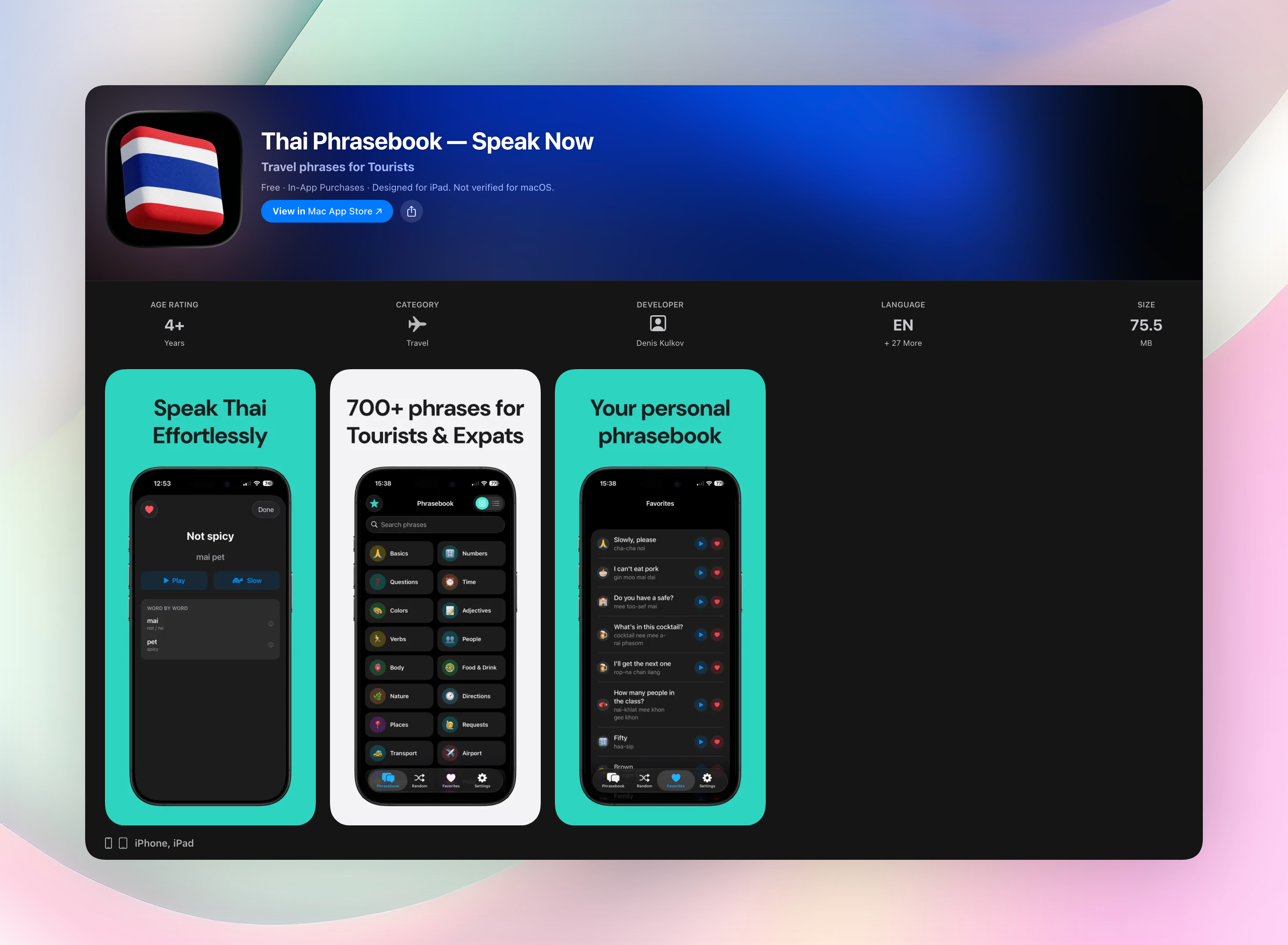
This is the only app on the list that hands you ready-to-use phrases for real situations. It skips verb tables and textbook explanations entirely. The phrasebook is curated for common traveller and expat moments: taxi directions, market haggling, hotel check-in, ordering food. Every phrase is recorded by a native speaker, not a robot, so you hear natural tones and rhythm. Offline access means it works when your SIM card fails or you’re deep in a night market with zero signal.
If you need Thai this week, not vocabulary for a test, this is the pick. Pimsleur locks you into 30-minute audio lessons paced over weeks. Here you tap a category, hear the phrase, and say it.
Standout features:
- 16 real-world categories (Transport, Food, Hotel, Shopping, Dating, Small Talk)
- Native audio on every phrase, at full and slow speed
- Word-by-word breakdowns that explain nuance without grammar-speak
- Favorites list to build a personal cheat sheet you can pull up in seconds
- Works fully offline, no account, no login, just open and speak
It won’t teach you to read or write Thai, and that’s intentional. For immediate spoken Thai, Get Thai Phrasebook or grab it on the App Store.
2. Duolingo
Best for: absolute beginners who want to slowly build reading recognition and first words, not conversational fluency.
Duolingo makes learning Thai feel like a game. Short, repetitive exercises focus on script and basic vocabulary. The free tier lowers the barrier to start, but speaking practice is minimal. The streak feature gives a daily nudge that keeps you showing up, a motivational trick Pimsleur’s rigid schedule lacks. Early levels sometimes use robotic voices, so tone training can be hit or miss. Pair it with a phrasebook for the speaking half, and you cover both reading and real-world talk.
3. Babbel
Best for: structured learners who want a syllabus and speech recognition, but only if you’re not studying Thai.
Babbel’s practical dialogue method and voice-recognition tech push you to say the words out loud. It’s a solid Pimsleur alternative for the languages it supports. Unfortunately, Babbel doesn’t offer a Thai course. For Spanish, French, or German, you get review sessions that recycle phrases and a clear learning path. A subscription costs a bit less than Pimsleur. For Thai, save your money and head to #1.
4. Rosetta Stone
Best for: visual learners who want to internalize sentence patterns without memorizing rules.
Rosetta Stone drops you into Thai from the first screen. No English translations, just images and audio. That mirrors Pimsleur’s avoidance of explicit grammar but adds a visual layer. The Thai course focuses on intuitive sentence building, and the TruAccent engine gives pronunciation feedback. It starts slow, which can frustrate anyone who just needs a quick phrase right now. Over time, though, the method builds solid tonal recognition. If you learn best by seeing and hearing at the same time, it’s a fit.
5. Mango Languages
Best for: budget learners who value cultural insight alongside vocabulary.
Many people get Mango free with a library card, which instantly makes it a cheaper Pimsleur alternative. The Thai course teaches polite, practical conversations and weaves in cultural notes that explain why a phrase works the way it does. Color-coded tone markers help you see the pitch of each word, something Pimsleur’s audio-only approach can’t show. The repetition style drills tonal memory gently. Check your local library’s digital resources. If Thai is available, you’re learning for free.
6. Memrise
Best for: visual reinforcement of pronunciation through real local clips.
Instead of studio voices, Memrise serves short video clips of native speakers saying phrases in real environments like markets, street stalls, and kitchens. That’s a big step up from Pimsleur’s disembodied audio. The flashcard system uses spaced repetition to drill vocabulary, and you can pick official Thai courses or user-generated decks. Quality varies, so stick to the “Learn with Locals” packs. It won’t teach you to build sentences from scratch, but for ear training and word recall, it’s a strong sidekick.
7. Busuu
Best for: self-study learners who want corrective feedback without hiring a tutor.
Busuu offers structured, CEFR-aligned courses with grammar tips and vocabulary practice, a bit more textbook-like than Pimsleur. A standout feature is the community: native speakers correct your written and spoken exercises. That real-human feedback is rare among apps. The catch? Thai isn’t a supported language currently. For the languages it does cover, its offline mode is handy for commutes. If you’re hunting for Pimsleur alternatives to speak Thai, this one doesn’t apply. Grab Thai Phrasebook - Speak Now instead.
8. LingQ
Best for: intermediate learners ready to move from textbook phrases to natural Thai.
LingQ flips the script. You learn by reading and listening to real content like podcasts, news articles, and imported YouTube videos, while tracking words you know. The built-in Thai library is modest, but the import feature lets you feed the app anything you find. Unlike Pimsleur’s scripted lessons, LingQ grows with your interests. It’s not a beginner tool; you’ll need about 100 words under your belt first. Pair it with a phrasebook to build that starter vocabulary, then let LingQ take you further.
9. Glossika
Best for: dedicated learners who can handle daily repetition to build automatic speaking reflexes.
Glossika uses a mass-sentence method. You type and speak full Thai sentences on a spaced repetition schedule. The focus on tonal accuracy and pattern recognition is the closest philosophy to Pimsleur’s audio drills, but for whole sentences rather than isolated phrases. The Thai course is extensive, and you can adjust the intensity. This isn’t a casual tool. Expect daily sessions that feel like practice, not play. If you want your mouth to form correct Thai without conscious translation, Glossika’s repetition will get you there.
How we picked these apps
We tested every app for at least a week and cross-referenced phrases with real conversations in Bangkok. The criteria: must teach or support Thai (with two exceptions included for their strong method, clearly noted), must favour speaking and listening, and must not be a dead app with a broken interface. We biased toward tools that get you producing Thai early, not just consuming lessons. Thai Phrasebook won the top spot because it solved the “I need to say something now” problem faster than any audio course: no sign-up, no lesson lock-in, just instant spoken help.
Frequently asked questions
Is Pimsleur good for learning Thai?
Pimsleur teaches useful Thai phrases with spaced repetition, but it’s slow and lacks written support. It works if you have weeks to spare.
What’s the best alternative to Pimsleur if I just want to speak?
Thai Phrasebook - Speak Now hands you ready phrases immediately. Glossika suits learners who prefer drilling full sentences daily.
Can I learn Thai for free with these apps?
Yes. Duolingo, Mango via library card, and Memrise’s free tier all offer free access. Thai Phrasebook - Speak Now’s paid approach avoids ads and subscriptions.
Which app helps with tones the most?
Glossika’s sentence repetition, Mango’s color-coded tone markers, and Memrise’s native-speaker videos each reinforce tonal accuracy in different ways.
Do any of these teach reading and writing?
Duolingo and LingQ cover Thai script. Thai Phrasebook - Speak Now is audio-only by design; it’s meant for speaking, not reading.
The verdict
Which alternative is right for you depends on what you want: speak today, drill sentences, or read Thai. Pick Thai Phrasebook - Speak Now for the fastest, simplest path to real phrases that work in daily life, with native audio and full offline access. Pair it with a free vocabulary app for long-term growth, but nothing on this list gets you speaking sooner. Get Thai Phrasebook and start talking.
Free Thai Phrasebook tools
- Basic Thai Phrase Pack GeneratorChoose a situation, pack size, and display order to create a focused set of Thai phrases with the app's vetted script, romanization, and English gloss.
- Greetings in Thai Phrase SelectorChoose a situation, result count, and display mode to see matching greetings from the Thai Phrasebook corpus.
- Thai Alphabet QuizPractice recognizing Thai consonants and vowel forms in either direction. Choose a set and quiz length, then get an instant score and review.
- Thai Number ConverterConvert whole numbers and decimals to Thai numerals, Thai written readings, or both without sending anything to a server.
- Thai Year ConverterConvert a Thai Buddhist Era year or full date to Gregorian CE—or convert Gregorian CE to Thai BE—using the standard 543-year offset.